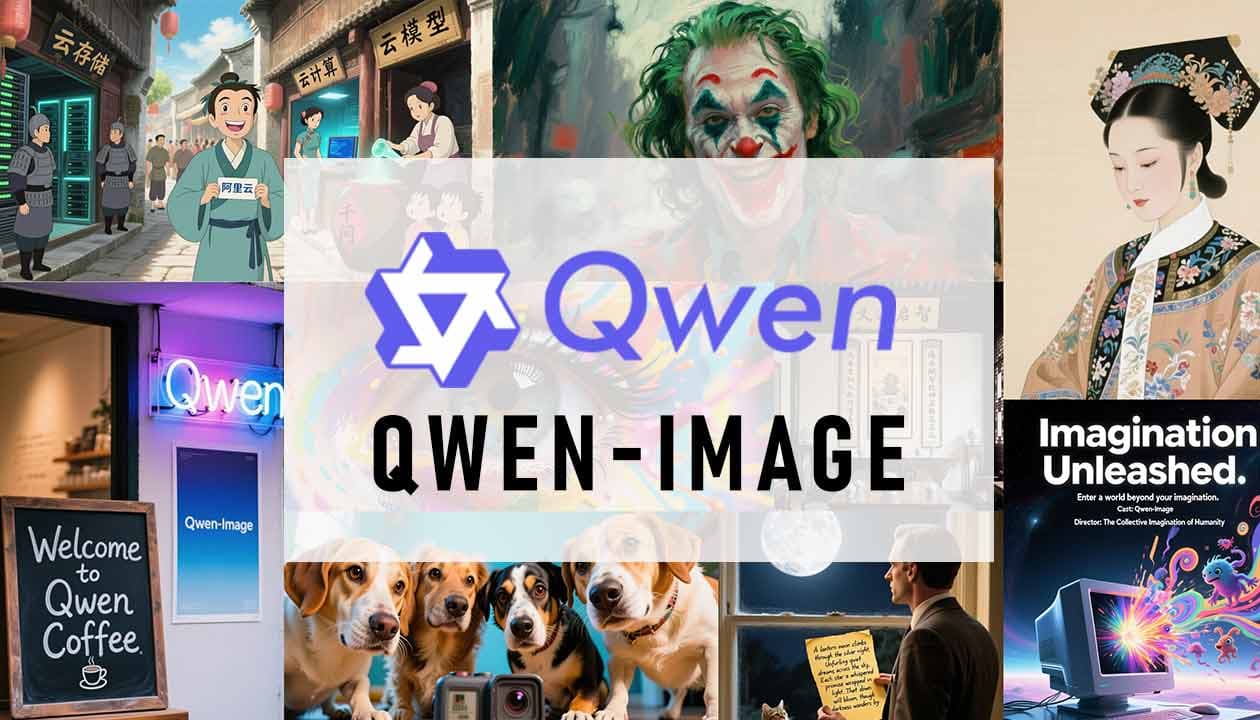
Qwen‑Image is a newly released 20B-parameter MMDiT image foundation model by the Qwen team that excels at both intricate text rendering and precise image editing. Unlike overlay methods, Qwen-Image integrates text into visuals seamlessly, accurately reproducing complex multi-line layouts and fine typographic details in both English and Chinese. Benchmark tests—across suites like GenEval, DPG, OneIG-Bench, GEdit, ImgEdit, and GSO—for both generation and editing show it achieves state-of-the-art results. In particular, on text rendering tasks such as LongText‑Bench, ChineseWord, and TextCraft, its performance surpasses previous models, especially in logographic languages. The GitHub repository confirms it is open-source under Apache‑2.0 license, and the team has also released weights, documentation, and demos simultaneously.
Community reactions—e.g., on Reddit’s r/LocalLLaMA—celebrate Qwen‑Image for its “stunning graphic posters with native text” and “especially strong” bilingual support. Users highlight its capabilities spanning photorealism to anime, minimalist design, and graphic poster styles. Qwen-Image also supports advanced editing tasks: style transfer, object insertion/removal, text editing within images, and human pose manipulation. It includes auxiliary understanding modules—semantic segmentation, object detection, depth/edge estimation, view synthesis, and super-resolution—making it a comprehensive visual foundation model for creation and manipulation where language, layout, and imagery converge.