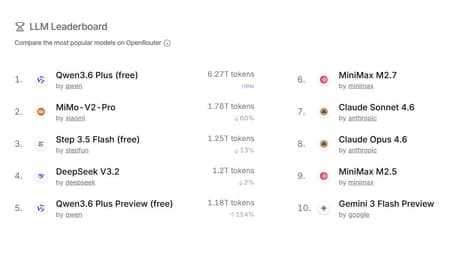
Recent analysis argues that open source AI might be the needle that bursts today’s AI bubble, because it undercuts the core assumption that only a handful of US tech giants can build and control state of the art models. Studies based on OpenRouter usage and Linux Foundation research show that open models are roughly six times cheaper per token on average than closed ones, yet deliver similar or quickly converging performance for many mainstream tasks, with the performance gap often closing within a few weeks of a big proprietary release. If companies systematically picked the best model on price plus quality, global users could save tens of billions of dollars each year.
At the same time, Chinese open weight ecosystems have surged. Benchmarks and Stanford HAI reports find that leading Chinese families such as Alibaba’s Qwen and DeepSeek are now in a statistical dead heat with US models across multiple leaderboards, and Qwen has overtaken Meta’s Llama as the most downloaded LLM family on Hugging Face. Many of these models ship as open weights, enabling fine tuning, self hosting and domain adaptation at very low marginal cost. This creates a hard strategic question for US vendors: how do you justify premium API pricing when a comparably strong open model appears days or weeks later, often for free or near free, and can be deployed behind a customer’s firewall.
If big government AI programs continue to overpay for proprietary stacks while enterprises quietly pivot to open alternatives, the market could reprice AI platforms sharply in favor of leaner, open centric players rather than today’s most richly valued incumbents.