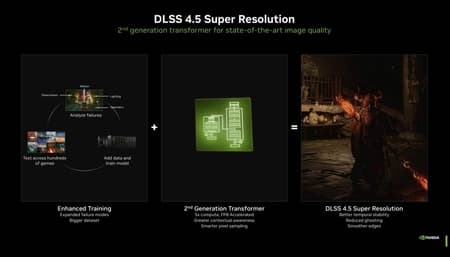
Unveiled at GTC 2026 and planned for a fall release, DLSS 5 is described as Nvidia’s biggest graphics shift since real time ray tracing, because it no longer focuses only on upscaling or frame generation but on using a learned neural model to “paint” more realistic lighting and materials into every frame. Instead of just cleaning up a low resolution image, the model takes color, motion vectors and 3D scene data, then adds effects like global illumination, subsurface scattering on skin, fabric sheen and more coherent reflections, all in real time up to 4K. Nvidia positions this as a way to get visuals close to high end VFX while still running interactively on consumer GPUs, with integration done through the existing Streamline framework and DLSS toolchain.
The most eye catching demos so far include Resident Evil with heavy path tracing, an Oblivion remaster, Starfield and other titles, but there is an important caveat: current showings at GTC run on two RTX 5090s, one GPU handling the game render and another dedicated to DLSS 5’s neural pass. Nvidia and early hands on coverage stress that this is just a development snapshot and that shipping builds should run on a single card, likely still focused on RTX 50 series power envelopes, but it raises the usual concerns about how accessible the best version of the tech will be.
Starfield in particular sits at the center of the debate, because it has already been a lightning rod for arguments about image quality, performance and heavy reliance on upscalers. Injecting an aggressive neural renderer on top of Bethesda’s art direction looks impressive in controlled demos, yet also fuels worries that DLSS 5 might override or distort original lighting and mood if it is pushed too hard. Nvidia’s answer is to give developers fine grained controls over intensity, color grading and masking so they can choose where DLSS 5 is allowed to change the look of a scene, and where it should stay out of the way. Support from major publishers like Bethesda, CAPCOM, Ubisoft and Tencent suggests the tech will show up widely, but for now DLSS 5 is clearly a work in progress that could be transformative if Nvidia can deliver similar results on a single GPU without too many visual artifacts.