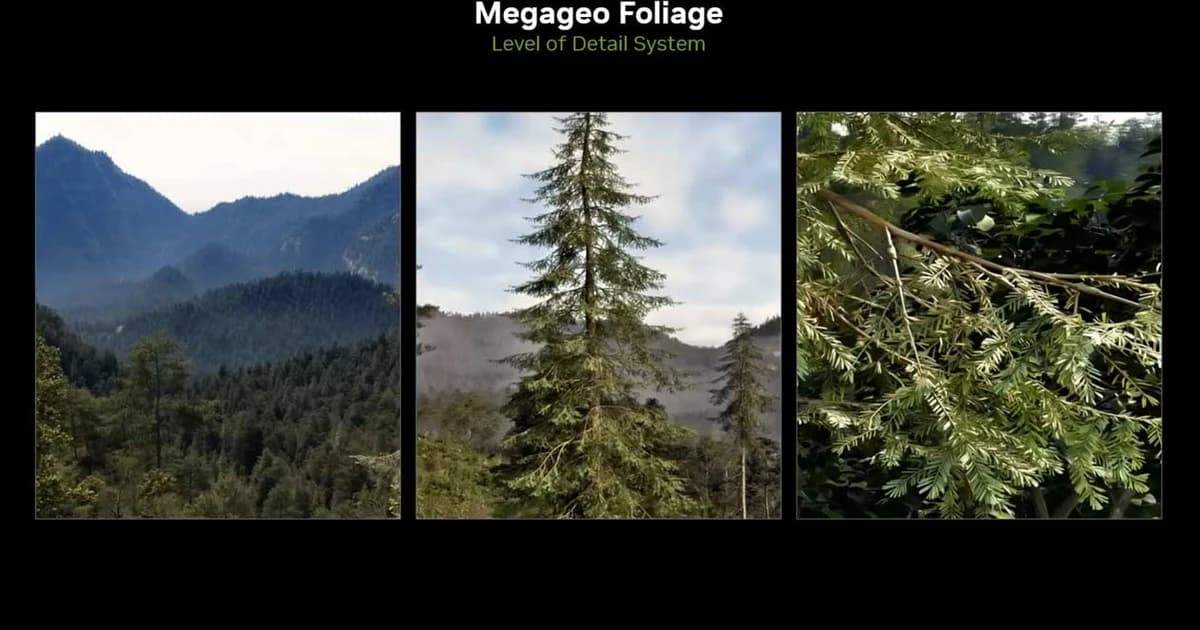
NVIDIA’s The Witcher 4 showcase matters because it is not just another pretty demo. It shows how RTX Mega Geometry can make extreme foliage density, path tracing, and real-time detail feel more practical in a large open-world game, while also reducing memory pressure and speeding up scene updates. In NVIDIA’s own explanation, the system compresses geometry into clusters, updates only the parts that matter, and can make ray tracing structures up to 100x faster to build than older methods. That is a big deal because forests, leaves, and other tiny repeating assets are exactly the kind of content that usually crushes performance in modern graphics pipelines.
The headline 4K 80 FPS result sounds huge, but it needs context. The demo reportedly ran on an RTX 5090 with DLSS Quality, so this is not raw native 4K performance and it is not final gameplay, but it still gives a useful picture of what a high-end path-traced scene can look like when the rendering stack is heavily optimized. The broader breakthrough is that NVIDIA and CD Projekt Red are showing a path toward dense, cinematic environments that do not immediately fall apart under the cost of ray tracing. If the tech scales well beyond the showcase, it could become a template for future open-world games that want both realism and speed.