Apple’s M5 Pro and M5 Max are the first Mac chips built on the new Fusion Architecture, which effectively links two 3 nm dies into a single SoC with a shared pool of unified memory. Both variants use an 18‑core CPU with six “super” high‑performance cores and twelve performance cores, bringing around 30 percent higher multicore performance compared with the previous generation M4 Pro and M4 Max in demanding pro workloads. Early reviews note that in CPU benchmarks the M5 Max can even edge out the older desktop‑class M3 Ultra in some multithreaded tasks, despite being a laptop chip, which underscores how much headroom Apple has squeezed out of its architecture.
On the graphics side, M5 Max scales up to a 40‑core GPU with per‑core AI accelerators and significantly higher memory bandwidth, delivering up to roughly 4x peak GPU compute for AI workloads versus the previous generation and around 35 percent better ray tracing than M4‑class chips at similar core counts. In Geekbench Metal, M5 Pro reaches about 141,000 points and shows a 24 to 26 percent uplift over M4 Pro, while M5 Max nearly matches Nvidia’s RTX 5070 Laptop in OpenCL and reaches about 88 percent of M3 Ultra’s performance in Apple’s Metal tests. Those numbers look impressive inside Apple’s ecosystem, especially for apps that are tuned for Metal and can use unified memory efficiently.
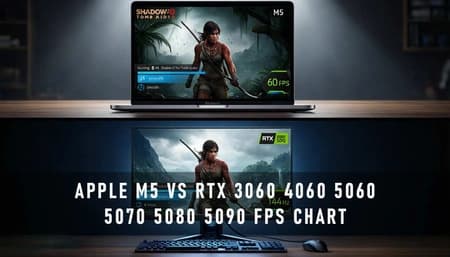
Once you step into cross‑platform GPU benchmarks, the picture becomes more nuanced. In OpenCL, which Apple has treated as deprecated on macOS for years, the M5 Pro scores around 87,155 points, whereas a GeForce RTX 5060 Laptop GPU comes in roughly 13 percent faster in the same test. That gap shows that Nvidia still has an edge in raw, broadly supported GPU compute, particularly for workflows built around CUDA, Vulkan, or cross‑platform OpenCL that are common on Windows and Linux. At the same time, the M5 family’s strengths lie in power efficiency, tight hardware‑software integration, and on‑device AI features driven by a faster Neural Engine and GPU‑level accelerators, which makes them very compelling for Mac users even if they do not always top every synthetic GPU chart against Nvidia’s latest laptop cards